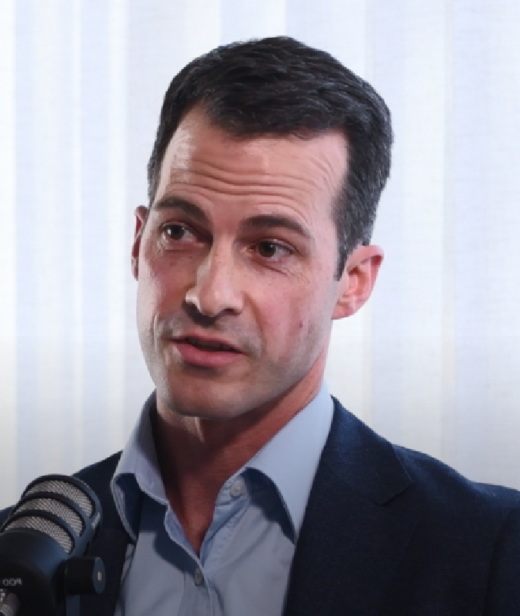
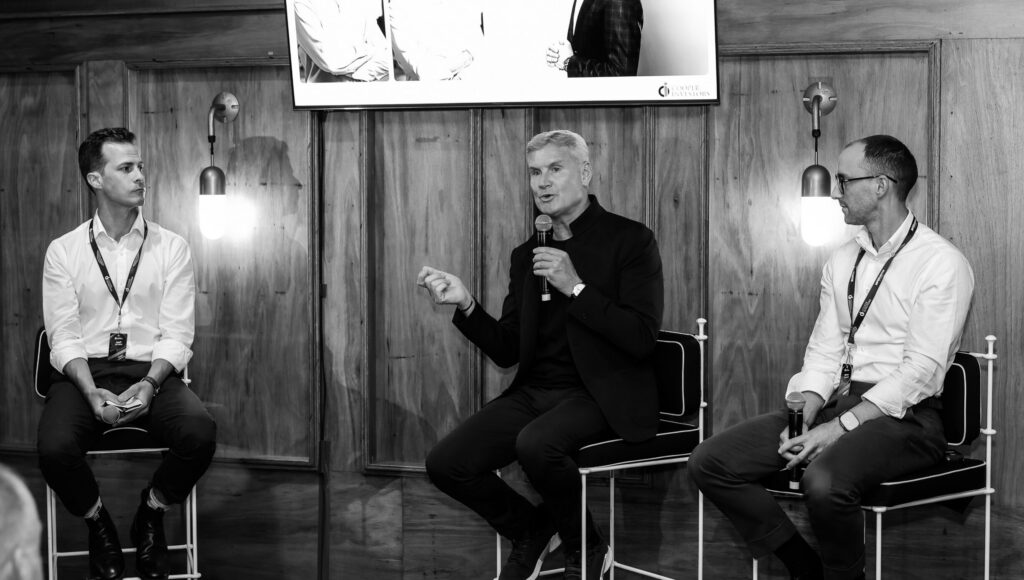
Geoff Di Felice and Marcus Guzzardi, Portfolio Managers of Cooper Investors (CI) Endeavour Fund, recently hosted 60 guests – investors, financial advisers and business leaders – amid the Melbourne Formula One frenzy for a discussion on one of the Fund’s holdings: Liberty Media, the commercial rights holder of Formula One and MotoGP™.
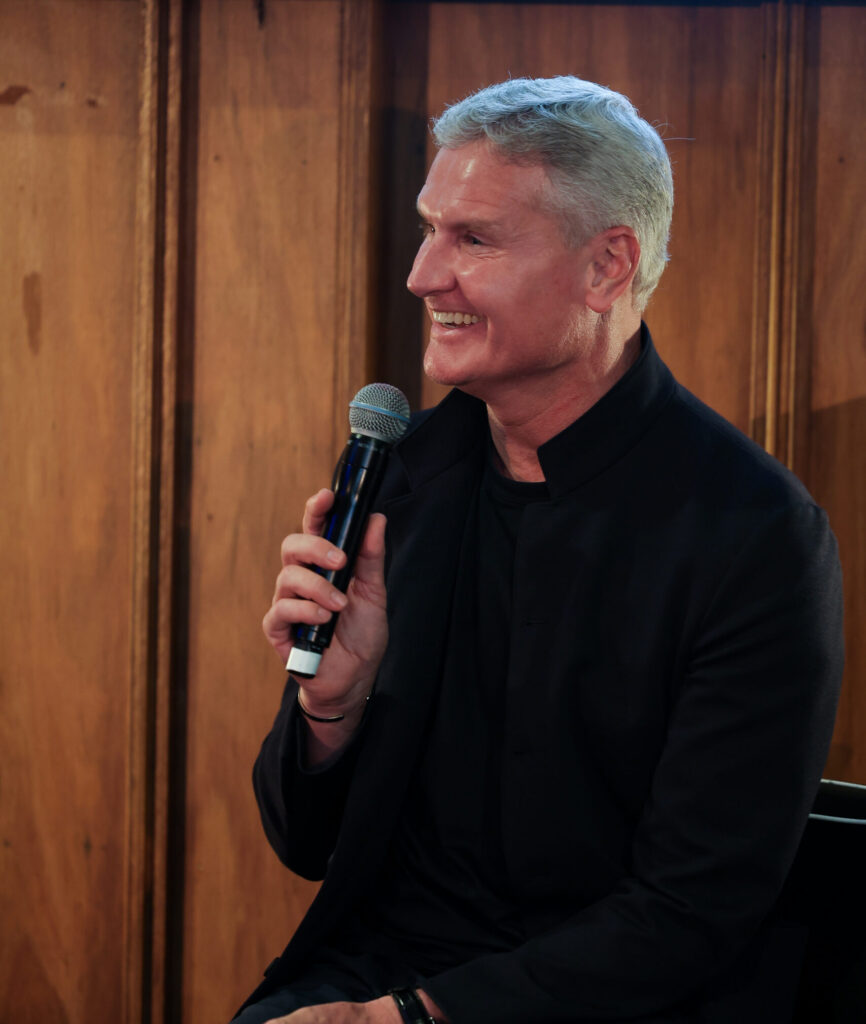
Joining Di Felice and Guzzardi in conversation was former Formula One driver and broadcaster David Coulthard, whose career has spanned the Bernie Ecclestone era and the sport’s transformation into one of the world’s most powerful sports entertainment brands.
The conversation covered high-performance psychology, the economics of global sports content, and the growth opportunities that emerge when a company like Liberty Media effectively unlocks latent value.
The discussion also highlighted the philosophy behind the Endeavour Fund. Di Felice and Guzzardi established the Fund to leverage their decade of investment experience developed at CI and to invest alongside Founder and Chief Investment Officer Peter Cooper in a concentrated portfolio of high-quality global businesses. Today, members of the CI team collectively represent more than A$35 million of the Fund’s capital, making them the largest combined investor and reinforcing a strong alignment with clients.
Let’s explore the thesis further, unpacking the insightful conversation between Di Felice, Guzzardi and Coulthard.
From Sponsorship Stickers to Global Partnerships
Liberty Media has transformed the sport of Formula One into a global entertainment and media platform, building value through media rights, race hosting fees and premium sponsorship, all while expanding its worldwide fan base.
According to Liberty Media’s recent investor update, since acquiring Formula One in 2017 for around US$6.4 billion, value has accrued steadily across the ecosystem, supported by an approximate 18% annualised return in the stock, rising team valuations and strong growth in global race attendance.
Luxury group LVMH, technology companies, financial institutions and consumer brands now view Formula One as a global brand marketing platform rather than a traditional sports sponsorship opportunity.
This shift reflects how the sport has evolved under Liberty Media, with the average Formula One team now generating roughly US$430 million in annual revenue, a figure that has tripled since the Liberty takeover.
A Business Built on Scarcity
One of the most interesting aspects of the Formula One business model is scarcity. There are typically 20 to 24 races on the calendar each year – all with exposure to global audiences.
That scarcity creates competition amongst three groups:
- Media companies competing for broadcast rights
- Cities competing to host races
- Global brands competing for sponsorship visibility.
Each of these revenue streams has grown meaningfully over the past decade. Streaming platforms, traditional broadcasters and technology companies all need premium content that attracts global audiences. And when multiple buyers compete for a scarce asset, pricing power tends to follow.
Guzzardi described sport as “the last bastion of live appointment viewing” – content that audiences still gather to watch in real time. In a fragmented media environment, that makes live sport extremely valuable.
Opening the Sport to a New Generation
Another major shift has been the engagement with fans. David Coulthard described how the previous era of Formula One was tightly controlled. Access to teams and drivers was limited, and the sport’s storytelling remained largely within traditional broadcast channels.
Liberty Media approached the opportunity differently. “They opened up the digital and social side of the sport,” Coulthard noted during the discussion. That openness coincided with the release of the Netflix series Drive to Survive, which introduced Formula One to millions of new fans around the world.
The result has been a noticeable demographic shift. The fan base is becoming younger and more diverse, with growing female participation (up 82% since 2017) and strong audience growth in markets such as the United States (+30% since 2017 to 52 million).
It’s safe to say that the sport has expanded beyond traditional motorsport audiences and into mainstream culture.
The Economics of the Platform
When we step back from the spectacle of the race weekend, the underlying economics of Formula One are compelling and offer attractive characteristics for investors; in particular, its free cash flow profile.
The sport benefits from long-term contractual revenues and relatively modest capital intensity. As global audiences and sponsorship demand grow, a meaningful portion of that additional revenue converts into free cash flow, reinforcing the compounding economics of the platform.
These revenue streams combine to produce a highly profitable business model. As Guzzardi highlighted during the event, the company successfully converts a significant portion of revenue into profit while continuing to grow the sport’s global reach.
High Performance and Decision-making
Operating under pressure was another theme that resonated throughout the discussion. In Formula One, decisions are made with limited information and very little time. As Coulthard explained, the sport forces drivers to develop a mindset where judgement and adaptability matter more than perfection. “In our sport we are making decisions at 200 miles an hour,” he reflected. “You make a decision, and if it proves to be bad, you learn from it and apply it the next time around.”
There are parallels with investing. Markets move, new information emerges and conviction is constantly tested. Di Felice noted that the discipline is not to avoid mistakes, but to recognise them quickly and adapt.
Adaptability is part of Cooper Investors’ philosophy of focusing on observation rather than prediction. It was the observation that sport is one of the few activities audiences still gather to watch in real time that contributed to Liberty Media taking its place on the grid with the other holdings in the Endeavour Fund.
The Next Phase of Growth
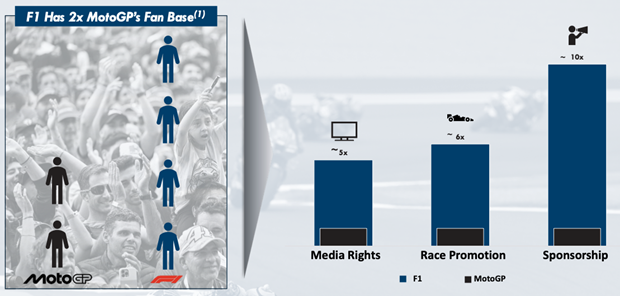
Another dimension of the Liberty Media story is the expansion beyond Formula One itself. The company recently acquired the commercial rights to MotoGP™, the world’s premier motorcycle racing series. MotoGP™ has a passionate fan base and global reach but historically has been monetised less effectively than Formula One.
The opportunity for Liberty is straightforward: apply the same commercial playbook that has driven the sport’s transformation over the past decade. If successful, the value creation could be meaningful.
Following Liberty Media’s successful acquisition of MotoGP™, Mark Shapiro, COO of TKO Group, which owns of UFC and WWE said, “We took a hard look at MotoGP™ and the full flywheel of monetisation opportunities around it…those assets are unicorns.”
Source: Company Filings
Investing in Next-generation Value Creators
As Di Felice and Guzzardi emphasised on the day, the Endeavour Fund was established to invest in businesses that they believe will shape industries over the coming decade.
These are typically companies with:
- visionary leadership
- scalable business models
- strong network effects
- long-term growth opportunities.
As Di Felice reinforced, “We seek to invest in companies and leaders that Harvard will be writing case studies about in 10 years’ time”, creating their own scarcity model by limiting the portfolio to 15 stocks. “If we find a great opportunity, it has to displace something already in the portfolio,” said Di Felice.
This clarity and confidence led Di Felice and Guzzardi to invest alongside Cooper Investors clients in the Endeavour Fund, as they seek to build a fund of next-generation value creators.
A Final Observation
Formula One is often viewed as pure spectacle. But beneath the noise of the engines sits a business with powerful structural characteristics: scarce assets, global demand, strong pricing power and expanding audiences.
The sport has evolved into a multi-billion-dollar global entertainment platform; and for long-term investors, those are the types of businesses worth studying closely. Because much like the drivers on the grid, the real objective is not simply to win the next lap or race, but to create an enduring legacy.
Missed the event on the day? Catch the highlights here.
See the full presentation here.
Find out more about the Endeavour Fund.